

Eurovision National Finals have one job: selecting a song to send to the contest and ideally win the whole thing. I’m stating the obvious – these are often competitions that only exist in connection with ESC and (unlike Sanremo, Melodifestivalen, or Festivali i Këngës) are by large structured/organized to mirror the ESC layout and voting system and would probably not exist if ESC didn’t. Great! Why is it that we so often complain about countries not sending competitive songs, then? First of all, it’s worth taking a step back to decide exactly what makes for a competitive Eurovision song in the first place. We know that juries generally like ballads, power vocals, and well produced, radio-friendly pop, and voters at home tend to embrace foreign language entries, folksy/ethno/dance vibes, and a big colorful party on stage. It’s a tough balancing act, if you think about it – it’s really no surprise that, since the introduction of the split voting system announcement 8 years ago, only three acts managed to come Top 2 in both sets of votes (Jamala in 2016 without topping either, Sobral in 2017, and Loreen in 2023) showing that by large, satisfying one set of criteria might come at the expense of the other. Only to some extent, let’s be clear – it’s virtually impossible to win Eurovision after performing particularly poorly with either juries or televote (ask Norway and North Macedonia in 2019), but it’s also true that when it comes to the most recent ESC winners, we’ve seen televote-topping songs land outside of the Top 3 with juries and, as recently as last month, a jury winner who wasn’t even Top 4 in the televote.
What happened at UMK (the Finnish national selection) this year is, however, unprecedented enough to warrant a bit of a deeper dive into the ways in which countries competing at ESC might have a selection process in place that is in practice a self-sabotaging trap. The ESC jury/televote split is essentially 50/50 (49.4/50.6 if we’re splitting hairs), ensuring that the winner will be an act that got comparable levels of support from industry experts as well as voters at home. Countries like Norway have slightly tweaked the ESC formula in favor of the televote (40/60 at Melodi Grand Prix) for the audience to have more of a say in the selection process. Unsurprisingly, these tweaks favoring songs that are generally crowd pleasers have, up to this point, failed to produce a Norwegian winner but have given us enduring, popular, beloved fan faves (Spirit in the Sky, Give That Wolf a Banana, Queen of Kings). That said, Finland has taken the ESC formula only to dramatically alter its balance – UMK chooses their competing act over a 25/75 jury/televote split. In theory, the contest is aiming to bolster the televote faves; in practice, this voting system is a huge waste of time, money, effort, and manpower. UMK has grown exponentially in estimation within the ESC fan bubble over the last few years: the show is and looks incredibly expensive, tickets usually sell out within the hour, and this year it found a new home at the Nokia Arena, the largest indoor arena in the country, to match record-high domestic TV ratings. In the end, Windows95man emerged as the winner, and let’s be clear – the math as laid out adds up and he won fair and square. Let’s look at the detailed final results for UMK 2024:

(Source: Wikipedia)
In entry fees alone, Finland spent in excess of 130K Euros on the contest this year. I tend to be somewhat judicious with my money, and if I was a country looking to send a song to Eurovision, I would make a point to send the song with the best return on my investment: the most competitive song. Granted, none of this mattered at last year’s UMK – Cha Cha Cha won both juries and televote, becoming immediately a hot fave at ESC. This year, things went a bit differently. No Rules! came dead last with the juries, and by quite some margin. It fared much better with the voters at home, obviously, but it wasn’t nearly as big a televote juggernaut as Cha Cha Cha was – Sara Siipola also scored in the 200’s, signaling widespread televote support for her entry, and she absolutely dominated the jury vote. This left us with a Top 2 made up of a song that won the televote and came in last with juries vs a song that came in second in the televote and first with the juries. Paskana would have won with virtually any other split that more closely approximates the voting at ESC – it would have won both on a 50/50 and on a 40/60 split:
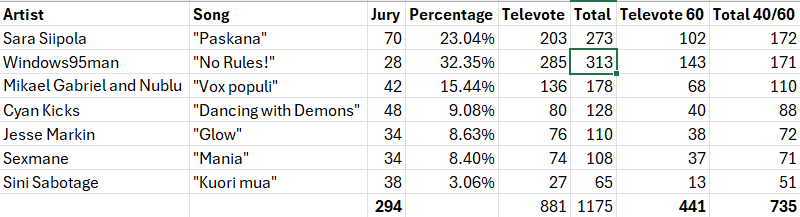
(UMK 2024 results on a 40/60 voting split as calculated by my loving math genius husband)
No Rules!‘s victory was the direct result of this disparate voting split which, by the way, skews so heavily in favor of the televote that juries are mathematically rendered null and void (I’m not just saying that – I have crunched the numbers to determine as much, and if you look at the overall ranking in the final, it mirrors exactly the televote ranking). This means that UMK is throwing money at international juries from 7 foreign countries, hiring music experts who are going to sit down to listen to and evaluate these songs and these performances, score and rank them, and these scores are then announced during the telecast only to mean nothing and have no impact whatsoever on the final result. That alone should be cause for Yle, Finland’s national public broadcasting company, to take a step back and just ask themselves, “Hold on a minute. Aren’t we literally just wasting money at this point?”
More egregiously, however, this year’s results told Finland already on the night of that they would not be sending a competitive song to Eurovision. The international juries roundly rejected No Rules! (especially considering that 12 of those 28 points came from the UK alone), and the televote did not conclusively establish the song as an overwhelming audience fave, either (for comparison, Käärijä last year scored 53% of the total televotes cast with Portion Boys in 2nd place with 14% vs 32% of the total televotes cast for Windows95man this year with Sara Siipola immediately behind at 23%). Even beyond more abstract considerations re: how No Rules! would have slotted into the 2024 roster compared to Paskana (this is obviously all speculation, but there is definitely an argument to be made that current ESC audiences have grown to reject joke/novelty entries that lack any meaningful musical quality, and No Rules! did stick out as a bit of an oddity in this year’s line-up, whereas Paskana would have very much followed in Tattoo‘s footsteps as the best dark pop/electronic ballad in the midst), a slightly more granular look at the math tells us that not only did Paskana gather far more consensus than No Rules! when considering both sets of votes, but so did two other songs (Dancing with Demons, which came 2nd with the juries and 4th in the televote, and Vox Populi, which came 3rd in both). For all intents and purposes, UMK ended up sending their 4th most competitive entry (in a field of 7), and for the most part the rest of Europe rejected it: as expected, international juries ended up ranking it in penultimate place, and the joke itself also proved to be mostly lost outside of Finland, as the song barely cracked the Top 15 in the televote (after qualifying out of its semi in 7th place, meaning that with juries still in the mix Finland would have probably failed to altogether advance to the final).
What about Paskana, then? Would it have fared better? For starters, it outsold the winner domestically, topping out at #2 on the Finnish charts whereas No Rules! never managed to crack the Top 5. The jury support Sara received at UMK was nearly identical to what we saw with Käärijä (70 points vs 72, and we know that Käärijä came in 4th place with juries at ESC), and the song/staging package was both striking and accessible, successfully marrying high and low concept as shown by the televote. A Top 10 finish would have not been out of the question. So, how do we fix this? First of all, Finland didn’t ask for my help and Finnish fans were ostensibly perfectly fine with their representative. But if I were Yle, or any other broadcaster facing such a conundrum, I would first and foremost push for the voting to adopt the same split used by ESC (like it or not – and I personally do – that’s how winners are chosen until further notice). Or…I would keep whatever split makes people happy, but still look at the math to help me figure out how I’m going to get the most bang for my buck. In this case, Windows95man still wins UMK – and no one can take that away from them – but the song I’m actually sending to Eurovision is Paskana, since that’s the one that’s got the best shot at doing anything worth investing in. Still, part of me remains fascinated with this practice of using flawed selection systems that seems to be endemic to a number of countries at Eurovision and would make no sense whatsoever in nearly any other context, expecially a business one (even if, in many ways, Eurovision is and remains a business insofar as you’re paying to enter and seeing how, in most cases, winning and hosting can be a boon for that country’s tourism industry). Ultimately, each country should be free to choose their representative however they please. That said, don’t go looking around for excuses if your entries fail to deliver. Chances are, the call is coming from inside the house.
 ESC Etc.
Leave a comment