
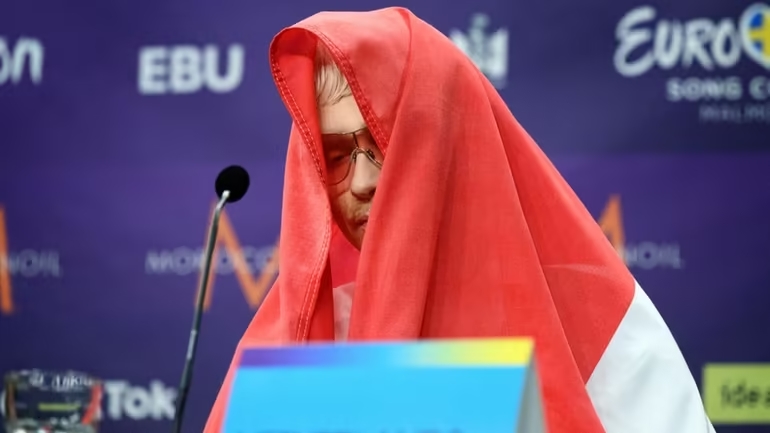
As we all know by now, Joost Klein, the Eurovision 2024 Dutch representative, was barred from participating in the ESC Grand Final due to an accident that occurred backstage shortly after his semifinal performance. The news rocked the ESC fandom bubble first before snowballing into a kind of international diplomatic incident, with the EBU, the Dutch broadcaster AVROTROS, various on-site national delegations, a number of press and online publications, and finally the local Swedish police getting variously involved over clashing reports regarding the nature and gravity of the accident itself, as well as the decision to disqualify the artist – a first in the history of the contest. Joost ended up in second place in his semifinal, and was arguably looking at a very likely Top 5 finish in the final.
AVROTROS was the first (and only?) outlet to release an official statement on the matter, within a day of the accident, which read as follows:
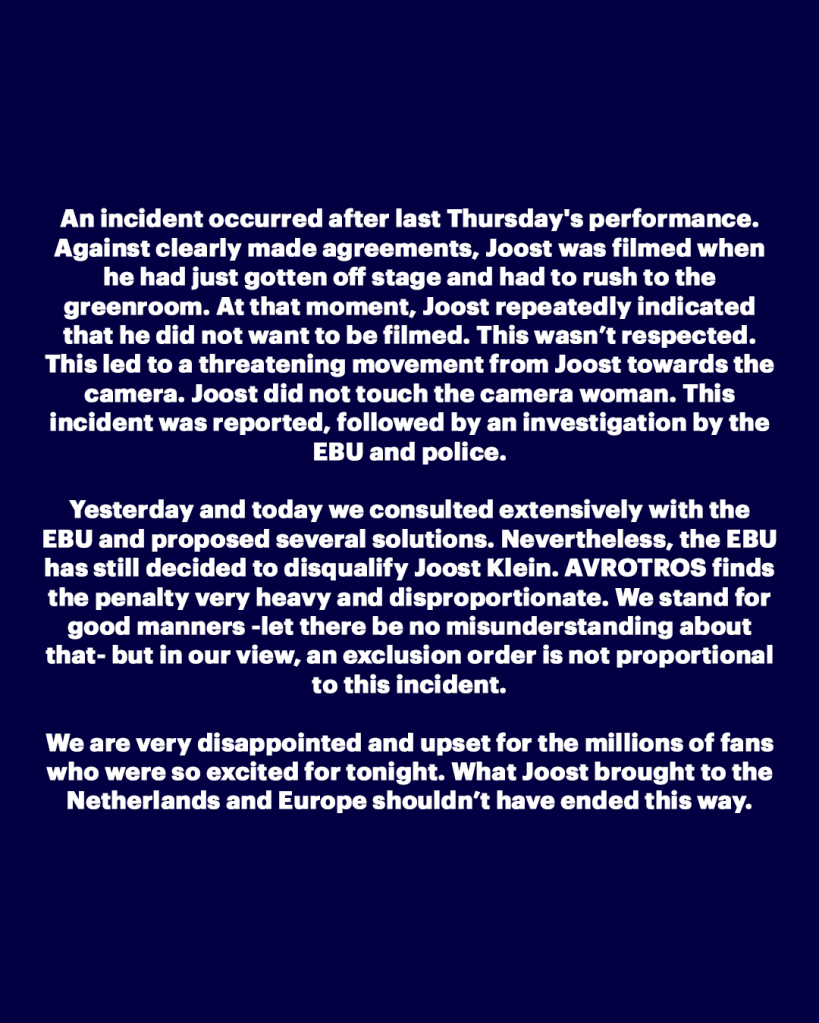
As of today, this is still the most detailed statement to be released by anyone on the matter. The EBU is yet to officially comment on the accident, as are the police officials in charge of the investigation, even though we know that Joost has requested for the Swedish authorities to collect additional reports from a number of Dutch witnesses and that his lawyer, Jan-Åke Fält, reiterated that the EBU and the Dutch delegation had an agreement concerning Joost‘s privacy off-stage that was not respected at the time of the accident. According to Fält, Joost asked the camera woman in question to stop filming him, and because she ostensibly refused to do so, he then proceeded to push the camera away from his face. One of the Swedish prosecutors, Fredrik Jönsson, appeared on the Dutch TV show RTL Boulevard to explain that the local officials involved in the investigation will contact those witnesses as requested by Joost. A full translation of the prosecutor’s TV statement reads as follows:
“The latest update is that it’s now handed over to the prosecution authority in Malmö. Joost Klein wants us to hear a couple of witnesses in the Netherlands. The Swedish police will not attend the hearings. We will send the questions to the Dutch police, and they will interrogate the witnesses. I haven’t seen any recordings. It will be, some… recording, I think? But I haven’t seen that. We aren’t able to have the case ready by that date. It’s hard to say how long it will take. It depends on, how I told you earlier, the Dutch police and how long that will take, but it’s hard to say. Maybe after the summer?“
That’s all we know for now. The following are simply some personal considerations/musings on what has transpired:
- I obviously do not condone any misbehaving of any kind, and I believe that workplace rules/regulations are in place to act as safeguards to protect workers who experience any such accidents. Clearly, the camera woman in question felt threatened enough to involve the police in the matter. I am also not an expert in the Swedish legal system to be able to determine which actions might violate such rules/extant legislations and which ones might be prosecutable under the law. I also do not hold any particular feelings in favor of or against Joost – Europapa was in my Top 10 at #10; by the same token, I also found the vaguely pro-Russian slant of some of his music/collabs confusing if not downright questionable.
- The Swedish prosecutors have not seen or been given access to any footage of the accident itself, and it isn’t clear whether such footage actually even exists at this point. I do not understand, then, how the EBU determined that Joost‘s actions were in breach of ESC regulations. What was the disqualification based on, exactly? Surely, it can’t just be the word of the camera woman with no additional, corroborating evidence? I completely understand that a worker claiming to have experienced an accident of this sort should unto itself be enough to immediately warrant launching an investigation and even seeking out the involvement of any and all relevant authorities, but in the absence of footage and/or conclusive evidence, a presumption of innocence as a basic legal principle should have allowed Joost to move forward with his participation. If/when found guilty, months from now as we’re being told, Joost could/should be then stripped of his result/placement, and the EBU should impose any additional penalties/sanctions as needed. As it is, however, this feels like a rather bizarre instance of executive overreach to me. What if Joost is cleared of any wrongdoing at the end of the investigation? What recourse does AVROTROS have at that point? What about their entry fee? What about all the participation costs?
- Why was this camera woman backstage filming Joost directly against agreed-upon stipulations? We’ve had examples in the past of artists who asked for and were granted special accommodations (Agnete in 2016 and Sobral in 2017, to name the most recent ones I can think of) to ensure their wellbeing. Did the EBU fail to communicate appropriately/effectively with the crew in this one instance? Did the camera woman just go rogue? Why did she continue filming him after being asked to stop? Who is being held accountable here? How do privacy laws work in Sweden? Purely hypothetical: let’s say Joost doesn’t swat at the camera, and instead he has a panic attack and ends up in the hospital and can’t perform. What then? It is just not clear to me what the EBU did, if anything at all, to ensure their agreement with AVROTROS would be enforced.
- I can’t help but feel like the EBU applied its own code of conduct/rules very liberally throughout the whole duration of the contest, almost on a case-by-case basis. An investigation by the local Swedish police over claims of a backstage altercation is enough to disqualify a country from the competition, but an investigation by the International Court of Justice over claims of mass genocide isn’t enough to disqualify another country from the same competition? What do these rules state exactly?
- Several journalists, artists, and delegations all reported being accosted and harassed by the same exact delegation throughout the week, but the EBU did not take any meaningful action to look into any of these claims beyond just acknowledging them. The broadcaster associated with that same delegation also aired disparaging remarks made live on air by commentators during Bambie Thug‘s performance, and an EBU representative told Bambie Thug and their delegation that this was in breach of the rules of the contest (as per a story posted by the artist on their Instagram account), but again the EBU ultimately took no punitive action in this instance, either.
- Does the EBU have a dedicated crisis commitee/set of procedures? We now know that no fewer than 5 countries were actively holding crisis talks with the EBU and were poised to withdraw from the contest as late as 25 minutes before the opening of the final. Who was involved in these talks? Were these trained professionals in crisis management/intervention?
- Why did the EBU not promptly release a clear and unequivocal statement regarding what had happened between Joost and the crew woman? Even more egregiously, why were all sorts of awful, unfounded rumors (“he beat her/he sexually assaulted her/he is on drugs/she ended up in the hospital”) allowed to run rampant all over social media prior to the AVROTROS press release? Why was I left looking for updates on Instagram for hours? How do defamation laws work in Sweden?
Again, it doesn’t look like we’ll have any conclusive answers until after this summer. I do however firmly believe that someone at the EBU needs to hold themselves accountable as we start looking at ESC 2025 in Switzerland next year. So much of what went down here feels like an utter failure in governance at nearly every structural level, and I fear the Netherlands and a number of other countries will just decide to tap out if we don’t see meaningful change within the EBU ranks. We’re not in a position where we can afford to lose any more countries, especially considering the fact that we will be traveling to an exceptionally expensive host destination, and Martin Österdahl has for better or worse completely compromised his tenure as the EBU Executive Supervisor in ways that are beyond repair at this point. Maybe let’s start from there.
 ESC Etc.
Leave a comment